The 5 Stages of Grief: What They Mean and What They Don’t
When we lose someone we love, we often look for an explanation for what is happening inside us.
Why do I feel numb today?
Why am I suddenly angry?
Why do I keep thinking, “If only I had…”?
Why do I feel so low?
And why can I sometimes feel okay, only to find myself overwhelmed again later?
You may have heard that grief happens in five stages: denial, anger, bargaining, depression and acceptance.
The Five Stages of Grief are one of the most widely known ways of talking about grief. But they are also one of the most misunderstood.
They are not a fixed sequence that every grieving person must follow.
You may experience some of these responses, several of them, all of them, or none of them in a clearly recognisable way. You may experience them in a different order, move between them, or experience several at the same time.
The stages can provide a language for understanding some experiences of grief—but they are not a roadmap that tells you how you should grieve.
Watch: Understanding the 5 Stages of Grief
Prefer to listen and learn?
In this video, I explain the 5 Stages of Grief—Denial, Anger, Bargaining, Depression and Acceptance—and, importantly, why these stages should not be understood as a fixed sequence that everyone must follow.
[Youtube Video: 5 Stages of Grief]
If you are navigating the loss of someone you love, I hope this video helps you understand that there is no single “right” way to experience grief.
What Are the 5 Stages of Grief?
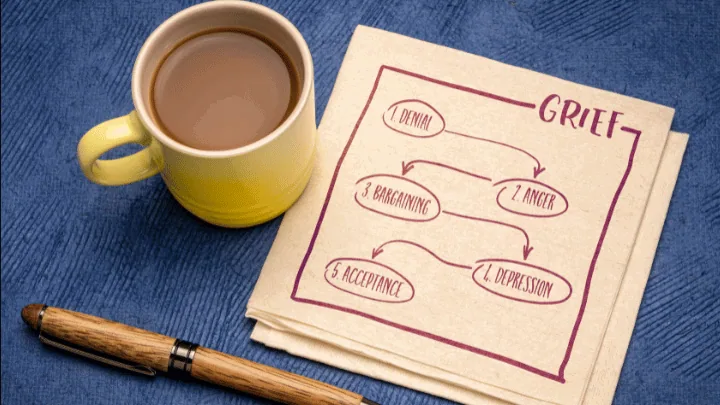
The Five Stages of Grief are:
- Denial
- Anger
- Bargaining
- Depression
- Acceptance
The model was developed by psychiatrist Elisabeth Kübler-Ross and was introduced in her 1969 book On Death and Dying.
Kübler-Ross originally developed the model while working with people facing their own terminal illness. Over time, the five stages became widely associated with grief following the death of a loved one.
This history matters because the model is often presented today as though it was originally designed as a universal, predictable sequence that every bereaved person follows.
It wasn’t.
The stages are better understood as possible emotional responses to loss, rather than steps that everyone moves through in order.
1. Denial
Denial can involve difficulty accepting the reality of what has happened.
After someone dies, the reality of the death may feel impossible to comprehend.
You may find yourself thinking:
“This can’t be happening.”
You may instinctively expect the person to walk through the door, call you, or be there when you reach for your phone.
Denial does not necessarily mean that a person literally refuses to believe that someone has died.
Sometimes it can look more like the mind gradually trying to take in a reality that feels too overwhelming to absorb all at once.
For some people, denial may be particularly noticeable immediately after a sudden death.
For others, it may appear in smaller moments long after the death—for example, when you instinctively reach for your phone to call the person before remembering that they are no longer there.
2. Anger

Anger can emerge in many forms after a death.
You may feel angry at:
- The situation
- Yourself
- Doctors or medical professionals
- Family members
- God or your spiritual beliefs
- The person who died
- The unfairness of what happened
Sometimes anger can feel easier to access than sadness.
You may find yourself asking:
“Why did this happen to us?”
“Why didn’t someone do more?”
“Why did this have to happen?”
Anger does not mean that you loved the person any less.
It can be one way that the mind and body respond to an experience that feels deeply unfair, painful or beyond your control.
3. Bargaining
Bargaining often involves thoughts about “if only” or “what if.”
You may find yourself thinking:
- “If only I had taken them to the doctor earlier.”
- “What if we had gone to another hospital?”
- “If I had called them that day…”
- “If I had done something differently, maybe they would still be here.”
These thoughts can create a sense that perhaps the outcome could somehow have been changed.
Bargaining is often closely connected with guilt and the desire to make sense of something that cannot be undone.
The mind can repeatedly revisit the past, looking for a different decision, a different conversation or a different moment that might have changed the outcome.
But hindsight gives us information that we did not necessarily have at the time.
Not everything that happened was within your control.
4. Depression

In the Five Stages model, depression refers to a deep sadness and awareness of the reality of the loss.
After the initial shock or other intense responses, the absence of the person may become increasingly real.
You may experience:
- Deep sadness
- Loneliness
- Loss of motivation
- Difficulty concentrating
- Changes in sleep
- Changes in appetite
- A sense of emptiness
- Withdrawal from others
You may simply miss the person.
You may miss their voice, their presence, their habits, or the ordinary life you shared.
It is important to remember that grief-related sadness is not automatically the same thing as clinical depression.
Grief and depression can overlap, but they are not identical experiences. If sadness or other symptoms become severe, persistent, or significantly interfere with your ability to function, seeking support from an appropriately qualified mental-health professional can be important.
5. Acceptance

Acceptance is often the most misunderstood of the five stages.
Acceptance does not mean:
- You are happy about what happened.
- You have forgotten the person.
- You no longer miss them.
- The loss no longer hurts.
- You have “moved on.”
Instead, acceptance can involve gradually recognising the reality that the person has died and beginning to understand how life will need to be lived in their absence.
You may still miss them deeply.
You may still have difficult days.
You may still experience sadness when you encounter a memory or an important date.
Acceptance does not require you to stop loving or remembering the person.
It can simply mean that the reality of the death has become something you are able to acknowledge while continuing to live.
Do You Have to Go Through All 5 Stages?
No.
This is one of the most important things to understand about the Five Stages of Grief.
You do not have to experience all five stages.
You do not have to experience them in this order.
You may experience one and never experience another in an obvious way.
You may experience several at the same time.
You may move back and forth between different experiences.
And your experience may not fit neatly into any of the five categories.
There is no grief checklist that you need to complete.
Do the 5 Stages Happen in Order?
Not necessarily.
Grief does not always move in a straight line.
You might feel that you have accepted the reality of the death and then experience intense anger several weeks later.
You might feel relatively peaceful one morning and overwhelmed by sadness that evening.
A birthday, death anniversary, festival, photograph, song or familiar place can suddenly bring a powerful emotional response.
This does not necessarily mean that you have “gone backwards.”
It may simply mean that grief is not linear.
Think of the stages as experiences, not steps
It may be more helpful to think of the Five Stages as possible experiences within grief, rather than five steps that lead from pain to recovery.
There is no requirement to reach Stage 5.
There is no failure if you experience Stage 2 after Stage 5.
And there is no deadline by which you are supposed to move from one experience to another.
What If My Grief Doesn’t Look Like the Five Stages?
That is okay.
You may experience grief in ways that do not resemble the Five Stages at all.
You might experience intense longing.
You might feel guilt.
You might feel relief.
You might become focused on practical responsibilities.
You might want to talk constantly about the person who died.
You might not want to talk about them at all.
You might feel emotionally numb.
You might experience moments of joy alongside sadness.
None of these experiences automatically means that you are grieving incorrectly.
Your relationship with the person who died was unique.
Your circumstances are unique.
Your grief will therefore be unique too.
Why Do People Find the 5 Stages Helpful?
Despite their limitations, the Five Stages can still be useful.
They give people a language for talking about experiences that can otherwise feel confusing.
Someone who recognises anger, bargaining or acceptance may feel less alone when they understand that other people have experienced similar responses.
The model can also help family members understand that grief may involve many different emotions and that there is no single emotional response to loss.
The problem comes when the model is treated as a prescription rather than a framework.
The question should not be:
“Which stage am I in?”
A more helpful question may be:
“What am I experiencing right now, and what do I need?”
The 5 Stages Are Not a Measure of Healing
One of the risks of thinking about grief as five stages is that we may start measuring ourselves against them.
You might think:
“I am still angry. I should have moved past this.”
Or:
“I felt okay yesterday, but today I am devastated. Am I going backwards?”
There is no need to measure your grief this way.
Healing after loss is not an examination that you pass by completing five stages.
The death of someone you love changes your life.
Learning to live with that change can take time, and the experience may continue to evolve.
A Different Way of Understanding Grief
At Heal Together Circle, I also use a different framework called The Six Needs of Grief.
The Six Needs of Grief is a framework I developed to describe some of the emotional needs that can arise when we are grieving the death of someone we love.
The six needs are:
- Witness Your Pain
- Express Your Feelings
- Release the Burden of Guilt
- Be Free from Old Wounds
- Integrate the Pain and Love
- Find Meaning in Life After Loss
The Six Needs are not stages.
They are not meant to be completed in a particular order.
Different needs may become important at different times, depending on the person and their circumstances.
This is one reason I prefer to focus not only on where someone is in their grief, but also on what they may need at this moment.
What Should You Remember About the 5 Stages of Grief?
The Five Stages of Grief can provide a useful vocabulary for understanding some common responses to loss.
But they are not a universal map of grief.
You do not have to experience all five.
You do not have to experience them in order.
You do not have to move through them within a particular period.
And you do not have to make your grief fit the model.
If you are grieving the death of someone you love, perhaps the most important question is not:
“Which stage am I in?”
Instead, ask:
“What am I experiencing right now, and what would support me through it?”
There is no single right way to grieve.
There is only your experience of losing someone who mattered to you.
And that experience deserves to be met with compassion rather than judgment.